

Differences Between Project Controls and Project Management: Key Comparisons and Roles
Many people think project management and project controls are the same thing, but they serve different purposes on a project. Project controls is a subset of project management that focuses specifically on managing cost and schedule, whilst project management oversees the entire project from start to finish. Understanding this distinction can help you build stronger project teams and deliver better results.

Think of it this way: a project manager is like the captain of a ship, leading the entire team towards the project goal. A project controller is like the navigation officer, tracking where the project is going and alerting the team about cost and schedule issues. Both roles are essential, but they handle different responsibilities.
This article will help you understand what makes these two functions different, how they work together, and why you need both for project success. You’ll learn about their core responsibilities, how they interact with each other, and how to apply these concepts in your own projects.
Understanding Project Management
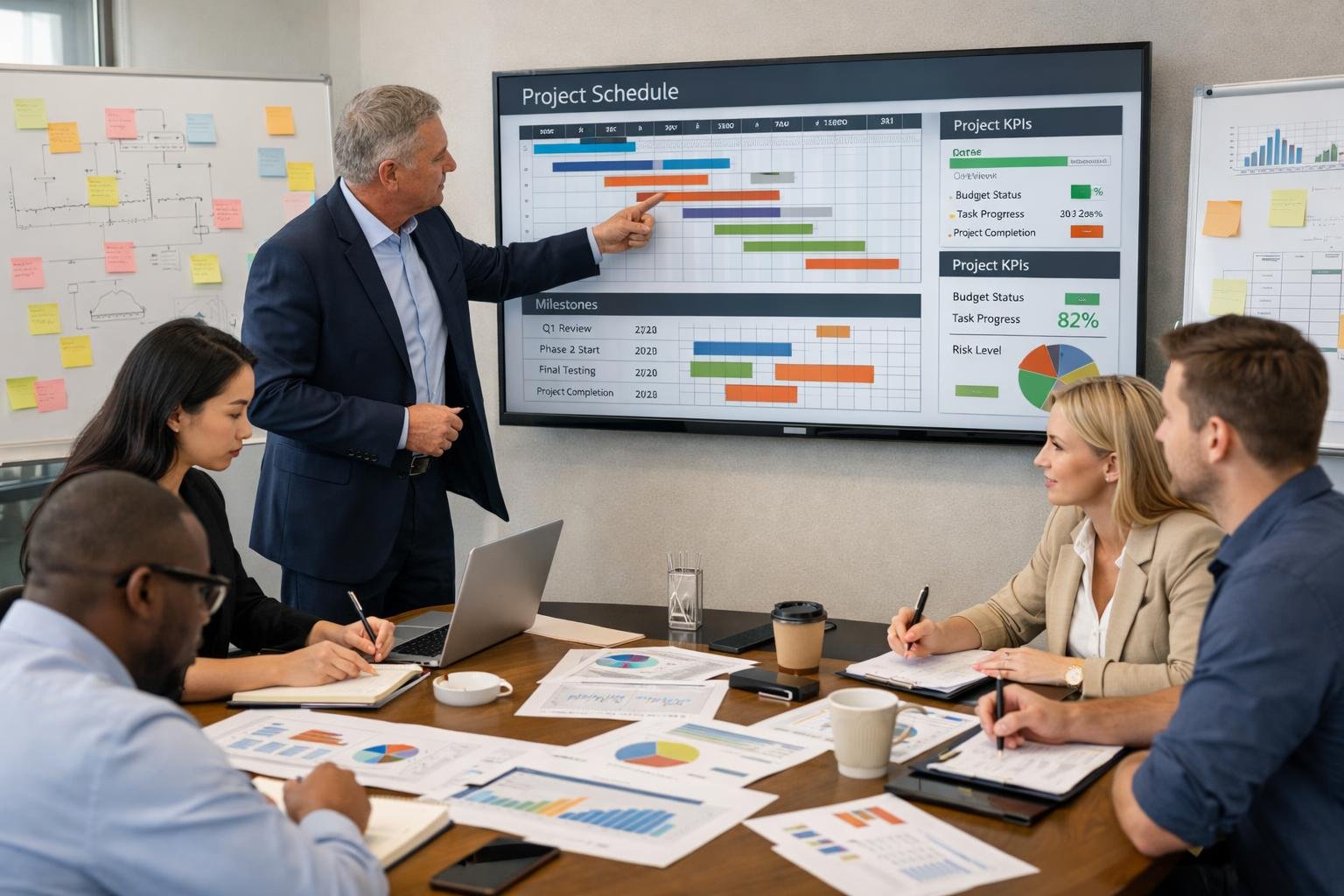
Project management is the structured approach to initiating, planning, executing, and closing work to achieve specific goals within defined constraints. A project manager leads teams through this process whilst balancing scope, time, cost, and quality to deliver successful outcomes.
Definition and Core Principles
Project management is the discipline of using specific knowledge, skills, tools, and techniques to deliver value to people. It involves coordinating resources and activities to meet project objectives within agreed constraints.
The core principles centre on balancing four primary constraints: scope, cost, time, and quality. You must manage these elements simultaneously to achieve your project’s goals. Scope defines what work your team will complete. Cost represents the budget available for project activities. Time indicates the schedule and deadlines you must meet. Quality determines the standards your deliverables must satisfy.
Project management requires you to work within these constraints whilst managing stakeholder expectations. Your project sponsor and other stakeholders need clear communication about progress, risks, and changes. The Project Management Institute provides standardised frameworks that guide these practices across industries.
Roles and Responsibilities of a Project Manager
Your role as a project manager involves directing the entire project team towards successful completion. You act as the captain, steering all activities and making critical decisions that affect project outcomes.
You are responsible for:
- Defining project objectives and success criteria with stakeholders
- Building and leading project teams with diverse skills and backgrounds
- Managing stakeholder relationships including clients, sponsors, and team members
- Allocating resources efficiently across project activities
- Monitoring progress and adjusting plans when needed
- Managing risks and developing mitigation strategies
You must balance competing demands whilst keeping your team focused on deliverables. This means making decisions based on information from various sources, including your project controls team. You consume data about cost and schedule performance to guide your choices. Your decisions directly impact whether your project meets its objectives on time and within budget.
Project Management Life Cycle
The project management life cycle consists of five distinct phases that structure your work from start to finish. Each phase requires different activities and deliverables.
Initiation is where you define the project at a high level. You develop the business case, identify stakeholders, and obtain approval to proceed. This phase establishes whether the project is viable and worth pursuing.
Planning involves creating detailed roadmaps for execution. You develop schedules, budgets, resource plans, and risk strategies. Your project controls team supports this phase by establishing cost estimates and timelines.
Execution is when your team performs the actual work. You coordinate people and resources whilst ensuring activities align with your plans. This phase requires constant communication and problem-solving.
Monitoring and controlling runs parallel to execution. You track performance against baselines, manage changes, and implement corrective actions. Your project controls team provides critical data during this phase.
Closure finalises all activities and formally ends the project. You complete final deliverables, release resources, and document lessons learnt.
Key Skills and Competencies
You need both technical and interpersonal skills to succeed as a project manager. Leadership abilities are essential because you must motivate teams and drive results without always having direct authority over team members.
Communication skills allow you to convey information clearly to diverse audiences. You must explain complex issues to executives, provide direction to your team, and negotiate with vendors. Strong communication prevents misunderstandings that could derail your project.
Problem-solving and decision-making capabilities help you navigate challenges. Projects rarely go exactly as planned, so you must analyse situations quickly and choose appropriate responses. Risk management skills enable you to anticipate problems before they occur.
Organisational skills keep multiple activities coordinated. You manage schedules, budgets, and resources simultaneously whilst tracking numerous details. Time management ensures you prioritise critical tasks and meet deadlines consistently.
Understanding Project Controls
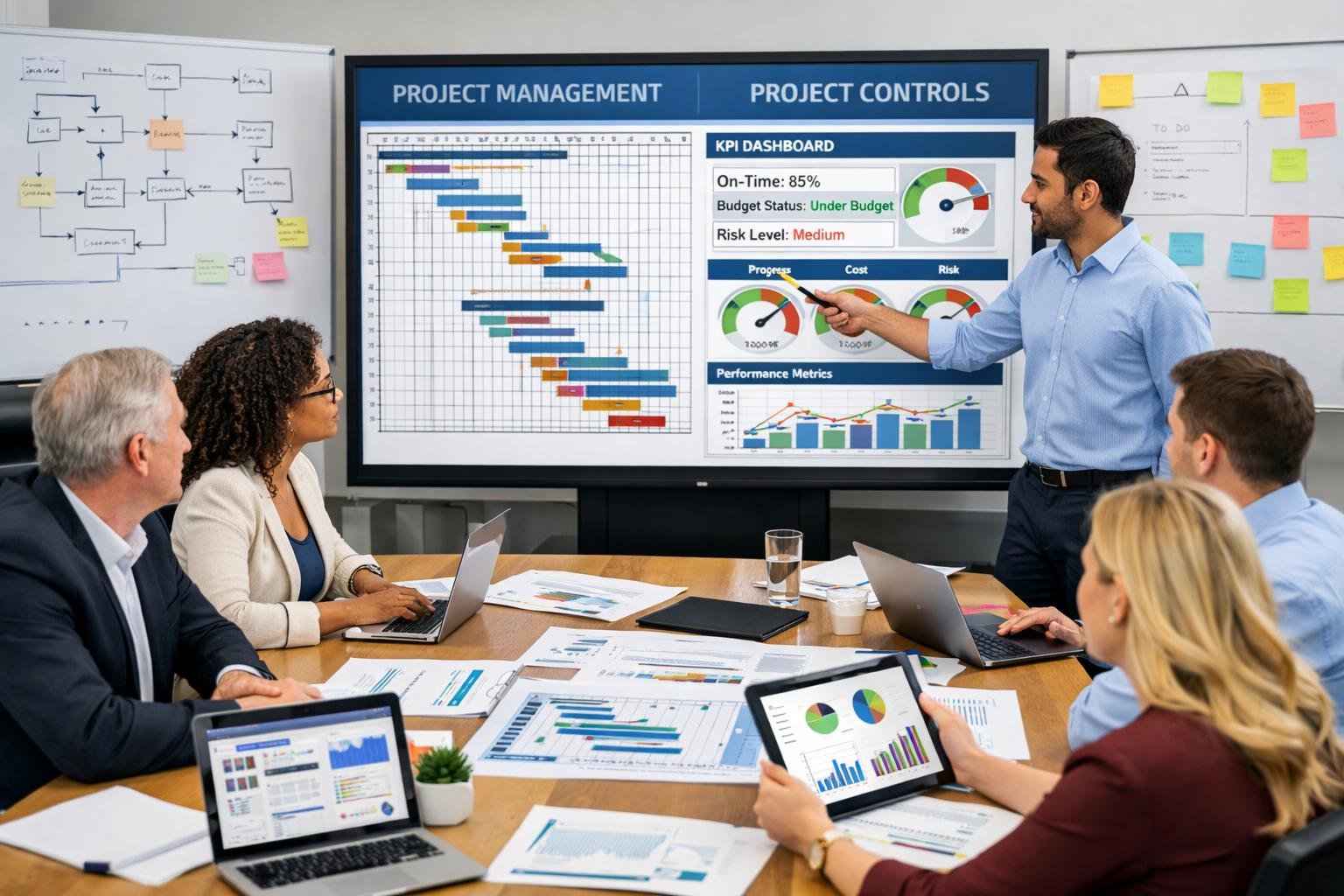
Project controls is a specialized function that manages cost and schedule through systematic planning, monitoring, and analysis. The project controls team develops baselines, tracks performance, and provides data-driven insights that help project managers make informed decisions.
Definition and Fundamental Concepts
Project controls focuses on two primary elements: cost and schedule. Your project controls team answers critical questions about project budgets and timelines. They determine how much the project will cost, whether it will finish on budget, and if it will complete on time.
This function differs from quality control or people management. Project controls manages financial and temporal aspects of your project through structured processes. The team creates baselines for comparison and develops forecasts based on current performance data.
Project controls operates throughout the entire project lifecycle. You need this function from initiation through closeout, not just during monitoring phases. Early involvement allows the project controller to develop accurate estimates and realistic schedules during proposal stages.
Roles Within Project Controls Teams
The project controls team typically includes several specialized roles. A project controller leads the team and reports directly to the project manager. Under this lead, you’ll find cost estimators, cost controllers, and planner/schedulers working together.
Cost controllers track expenditures against budgets and analyze spending patterns. They identify variances and help develop recovery plans when costs deviate from targets. Planner/schedulers manage project timelines, monitor progress, and update schedules based on actual performance.
Team size varies with project complexity. Large projects might employ multiple specialists in each role. Smaller projects may have one or two people covering multiple functions. Some organizations include document controllers within the project controls team structure.
Project Controls Processes
Your project controls processes begin with developing foundational documents. The team creates project cost estimates, budgets, resource plans, and detailed schedules. They establish the work breakdown structure (WBS) and cost breakdown structure (CBS) that organize project information.
The team then establishes baselines that serve as performance benchmarks. These baselines provide reference points for measuring progress and identifying deviations. Throughout execution, project controllers collect data from team members across all disciplines.
They analyze this information to produce performance reports and forecasts. These reports show current status, predict future performance, and highlight potential issues. The project controller identifies cost and schedule concerns early, then develops recovery strategies.
This advisory role means the project controller recommends solutions rather than directing work. You receive data-driven insights that inform decisions, not instructions on what to do.
Project Control Systems and Tools
Modern project control systems integrate data collection, analysis, and reporting functions. These platforms manage vast amounts of information from multiple sources across your project. Specialized software helps track costs, schedules, resources, and performance metrics in real time.
Tools like Proteus and systems from providers such as Xergy Group support complex project controls processes. These platforms enable your team to maintain accurate baselines, process updates efficiently, and generate analytical reports quickly. They facilitate data-driven decisions by presenting information in accessible formats.
Your project control system must interact with other project management tools. It pulls data from engineering teams, procurement, construction, vendors, and subcontractors. This integration ensures comprehensive visibility across all project elements that affect cost and schedule performance.
Key Differences Between Project Controls and Project Management

Project controls and project management work together but serve different functions in delivering successful outcomes. Project controls focuses specifically on cost and schedule management, while project management handles the entire project lifecycle including scope, quality, and team direction.
Scope and Focus
Project controls concentrates on two primary elements: cost and schedule. You’ll find project controllers developing cost estimates, managing the project budget, and creating project schedules to track when tasks should be completed. They answer questions about how much the project will cost and whether it will finish on time.
Project management covers a broader range of responsibilities. You oversee the entire project lifecycle from initiation through planning, execution, monitoring and controlling, to closeout. Your focus includes managing scope, quality, resources, and stakeholder expectations alongside cost and time constraints.
The difference between project controls and project management becomes clear when you consider that project controls is actually a subset of project management. While project controllers manage specific data about costs and timelines, project managers must balance all project constraints to achieve project success.
Decision-Making and Information Flow
Project controllers generate information about project performance through analysis and reporting. You collect data from various team members, create forecasts, and identify potential issues with the project budget or schedule. Your role involves producing analytical reports that show where the project currently stands.
Project managers consume this information to make decisions. You receive the reports, graphs, and recommendations from project controllers and use them to direct the project team. The project controller advises you on possible recovery plans when problems arise, but you make the final decisions about which actions to take.
This creates a clear information flow. Project controllers act as advisers who provide recommendations and strategies, whilst you hold the authority to implement changes and direct team members.
Team Structure and Reporting
Project controls teams typically include cost estimators, cost controllers, and planner/schedulers. These specialists report to a project controls lead or manager, who reports directly to you as the project manager. The size of the team varies based on project complexity.
You lead a much broader team structure. Under your direction, you’ll have various functional managers such as engineering managers, construction managers, and quality managers, each with their own teams. The project controls team interacts with all these groups to gather cost and schedule data.
Project controllers need access to information from across your project. They track budgets for different departments, monitor milestone delivery, and analyse project risk across all areas to maintain control of the overall cost and schedule.
Integration Across Project Phases
Project controls must be involved throughout the entire project lifecycle, not just during monitoring and control phases. You need project controllers from the initiation stage when you’re preparing proposals and developing initial cost estimates and high-level schedules for your project planning.
During execution, project controllers continuously track project performance against baselines. They measure deviations, analyse trends, and help you understand whether corrective actions are needed. Their ongoing involvement in project monitoring and controlling ensures you receive timely information about cost and schedule status.
As you move through different project phases, project controllers adapt their focus. Early stages require estimation and baseline development. Later phases demand detailed tracking and forecasting to support your decision-making and maintain project success.
Core Functions: Processes and Techniques
Project controls relies on specific processes and techniques to manage cost and schedule data throughout a project’s lifecycle. These functions generate the information that project managers need to make informed decisions and keep projects on track.
Forecasting and Performance Measurement
Forecasting provides essential insights into where your project is heading based on current performance data. Project controllers use earned value management to measure work progress against planned schedules and budgets. This technique compares the value of work completed to the amount spent and the time taken.
Real-time earned value tracking allows you to spot problems early. You can see if your project is running over budget or behind schedule before issues become critical. Performance management involves monitoring key performance indicators (KPIs) that measure productivity, efficiency, and resource utilisation.
Project controllers analyse trends in your project data to predict final costs and completion dates. These forecasts help you understand whether you’ll finish on budget and on time. Automated reporting systems can track real-time data and generate performance reports that highlight deviations from your baseline plan.
Cost Management and Control
Cost management starts with creating detailed budgets and allocating funds across different work packages. Project controllers track actual spending against planned budgets throughout the project. They monitor cost overruns and identify areas where expenses exceed estimates.
Cost control involves regular analysis of expenditures and variance reporting. You receive detailed breakdowns showing where money is being spent and how it compares to your budget. Project controllers use cost tracking systems to capture expenses from vendors, subcontractors, and internal resources.
Automated reports provide up-to-date financial information without manual data collection. These reports show committed costs, actual costs, and forecasted costs at completion. Project controllers also manage budget changes and track the impact of scope variations on overall project costs.
Change and Risk Management
Risk management identifies potential threats to your project’s cost and schedule objectives. Project controllers conduct risk analysis to assess the probability and impact of various risks. This process helps you understand which risks need immediate attention and mitigation strategies.
Change management processes track modifications to project scope, schedule, or budget. Every change request goes through evaluation to determine its impact on cost and timeline. Project controllers quantify these impacts so you can make informed decisions about approving or rejecting changes.
Risk mitigation strategies might include adding contingency reserves or developing alternative approaches. Project controllers monitor risk registers and update them as new risks emerge or existing risks change. They also track the effectiveness of mitigation actions and adjust strategies when needed.
Collaboration and Interaction Between Project Controls and Project Management
Project controls teams and project managers work together through data sharing, coordinated reporting, and joint risk monitoring to ensure projects stay within budget and on schedule. This partnership strengthens project delivery by combining strategic oversight with detailed performance tracking.
Information Sharing and Reporting
Your project controls team provides the data that drives your management decisions. They track costs, monitor schedules, and generate performance reports that show exactly where your project stands. This information flows to you regularly through dashboards, weekly reports, and progress meetings.
The project controller gives you real-time insights about budget spending, timeline progress, and resource allocation. You use this data to adjust plans, reallocate resources, or address problems before they grow. For engineering projects, this might include tracking design hours, material costs, or construction milestones.
Key data shared between teams:
- Budget status and forecasts
- Schedule performance metrics
- Resource utilisation rates
- Change order impacts
- Risk exposure levels
This two-way exchange means you inform project controls about upcoming changes whilst they alert you to variances in your resource plan or spending patterns.
Supporting Project Delivery and Success
Project controls support your work from project execution through to project closure. They monitor project health by comparing actual performance against baselines, which helps you spot issues early. When you need to make strategic decisions about scope, timeline, or budget, project controls provide the evidence you need.
Your collaboration ensures project delivery stays on track. If a task falls behind schedule, project controls quantify the delay and model recovery options. You then decide which approach to take based on their analysis. This partnership proves essential for project professionals managing complex deliveries where small delays can cascade into major problems.
The controls team also maintains documentation throughout the project lifecycle, which supports smooth project closure and provides lessons for future work.
Mitigating Project Risks and Scope Creep
You rely on project controls to identify risks before they materialise. They analyse trends in your project data to flag potential cost overruns, schedule delays, or resource shortages. This early warning system lets you take corrective action whilst options remain available.
Project controls help you manage scope creep by tracking all change requests and quantifying their impact on budget and timeline. When stakeholders request additions, the controls team shows you exactly what each change costs in time and money. You then make informed decisions about which changes to approve.
For engineering projects, this might involve evaluating how design changes affect procurement schedules or construction sequences. Your project controls team models different scenarios so you understand the full implications before committing to a path. This collaborative approach protects project delivery from uncontrolled expansion that threatens deadlines and budgets.
Industry Applications and Best Practices
Project controls and project management work differently across industries, with each sector requiring specific approaches to cost and schedule management. The right software tools and integration strategies help teams deliver projects on time and within budget.
Sector-Specific Considerations
Construction and engineering projects rely heavily on project controls to track material costs, labour hours, and equipment usage. Your project controller monitors daily progress reports and compares them against baseline schedules to identify delays early.
In the oil and energy sector, project controls focus on managing long-term capital expenditures and complex supply chains. These projects often span multiple years, requiring detailed forecasting models and risk management strategies. Your team needs to account for regulatory compliance and environmental factors that can impact both cost and schedule.
IT and software development projects use project controls differently. You track sprint velocities and resource allocation rather than physical materials. The focus shifts to managing scope changes and technical debt whilst maintaining delivery timelines.
Manufacturing projects require tight integration between project controls and procurement teams. Your cost controllers must monitor vendor performance, material deliveries, and production schedules simultaneously to prevent bottlenecks.
Adopting Project Management Software
Project management software centralises data from all project teams into one accessible platform. You can track budgets, schedules, resources, and risks in real-time rather than waiting for weekly reports.
Modern tools offer specific features for project controllers:
- Cost tracking modules that link expenses to work breakdown structures
- Schedule analysis tools for critical path calculations
- Earned value management dashboards for performance monitoring
- Forecasting capabilities based on historical data
Your project manager uses the same software to assign tasks, monitor team workload, and communicate with stakeholders. This shared platform eliminates duplicate data entry and reduces reporting errors.
Cloud-based solutions allow remote teams to update progress simultaneously. You can access current project status from any location, which proves essential for multi-site projects.
Achieving Project Objectives Through Integration
Your project controller generates cost and schedule reports whilst your project manager uses this information to make decisions. This relationship only works when both functions communicate regularly and understand each other’s needs.
Weekly coordination meetings between project controls and management teams prevent surprises. You review forecast variances, discuss recovery options, and align on priorities before issues escalate.
Integration requires clear data protocols. Your team must define how information flows between departments, what metrics matter most, and who approves changes. Without these standards, your project management software becomes a data repository rather than a decision-making tool.
The project controller advises on technical solutions for cost or schedule problems. Your project manager evaluates these recommendations against broader project constraints like quality requirements and stakeholder expectations. Together, you create balanced solutions that keep the project moving forwards.
Frequently Asked Questions
Project controllers focus on cost and schedule management whilst project managers direct the entire project team and make strategic decisions. These roles work together but serve different purposes in bringing projects to successful completion.
What are the distinct roles of a project controller versus a project manager?
A project controller manages two specific elements: cost and schedule. They create budgets, develop project schedules, and track how the project performs against these plans. Their job involves generating reports that show whether the project will finish on time and within budget.
A project manager handles all aspects of the project from start to finish. They direct the work of the entire team and balance multiple constraints including scope, cost, time, and quality. The project manager makes the final decisions for the project based on information provided by various team members.
The project controller acts as an advisor to the project manager. They provide data, analysis, and recommendations about cost and schedule issues. The project manager then uses this information to make informed decisions about how to proceed with the project.
How do project controls contribute to risk management within a project’s lifecycle?
Project controls help identify potential cost and schedule problems before they become critical. The project control team monitors performance data and spots deviations from the plan early. This early detection allows the team to develop recovery plans and alternative strategies.
Your project control team analyses trends in spending and progress. They forecast where the project is heading based on current performance. When they see risks emerging, they present options to the project manager for corrective action.
The team maintains contingency plans for both cost and schedule. These plans provide buffers against unexpected issues. Project controllers track how much contingency has been used and advise when additional reserves might be needed.
Can project controls exist independently of project management, and if so, how?
Project controls cannot exist independently of project management. They function as a subset of project management rather than a separate discipline. The project control team reports directly to the project manager and relies on input from all other project teams.
Project controllers need information from technical leads, procurement staff, construction teams, and vendors. Without the broader project management framework, they would have no context for their cost and schedule work. The project manager provides the overall direction that gives meaning to the project control activities.
The value of project controls comes from supporting project management decisions. Without a project manager to act on their recommendations, project controllers would simply generate unused reports and data.
What are the primary responsibilities of a project control team?
The project control team develops the project’s cost estimate and budget at the start. They create the project schedule and establish the baseline against which progress will be measured. This planning work happens during the initiation and planning phases.
Throughout the project, they collect data from all team members about actual costs and progress. They compare this actual performance against the baseline plan. The team calculates variances and analyses why the project is ahead or behind schedule or over or under budget.
They produce regular status reports for the project manager and stakeholders. These reports show current performance, forecast final costs and completion dates, and highlight areas of concern. The team also develops recovery plans when the project deviates from its targets.
How does the function of a Project Management Office (PMO) differ from that of project controls?
A PMO typically oversees multiple projects across an organisation. It establishes standard processes, methodologies, and templates that all projects should follow. The PMO focuses on organisational-level governance and portfolio management.
Project controls work at the individual project level. They deal with the specific cost and schedule details of one project. Whilst a PMO might set the standards for how cost and schedule should be managed, the project control team implements those standards on their particular project.
The PMO often provides resources and support to project teams, including project controllers. However, the PMO’s scope extends beyond cost and schedule to include areas like project selection, resource allocation across projects, and strategic alignment.
In what ways do project controls impact the overall success of project delivery?
Project controls provide visibility into the project’s financial health and timeline status. This visibility allows the project manager to make timely decisions before small problems become major failures. Early warning of issues gives the team time to implement corrective actions.
The project control team’s forecasts help stakeholders understand whether the project will meet its objectives. Accurate forecasting enables better resource planning and helps manage client expectations. When everyone knows the realistic completion date and final cost, they can plan accordingly.
Strong project controls create accountability throughout the project team. When cost and schedule performance is tracked and reported regularly, team members understand the impact of their work. This accountability often leads to better performance and more careful use of project resources.
Looking for a Career Change?
Check out our latest Job Listings