
What Makes a Great Planner? | Planning & Project Controls
What Makes a Great Planner? Turning Programme Data into Decisions
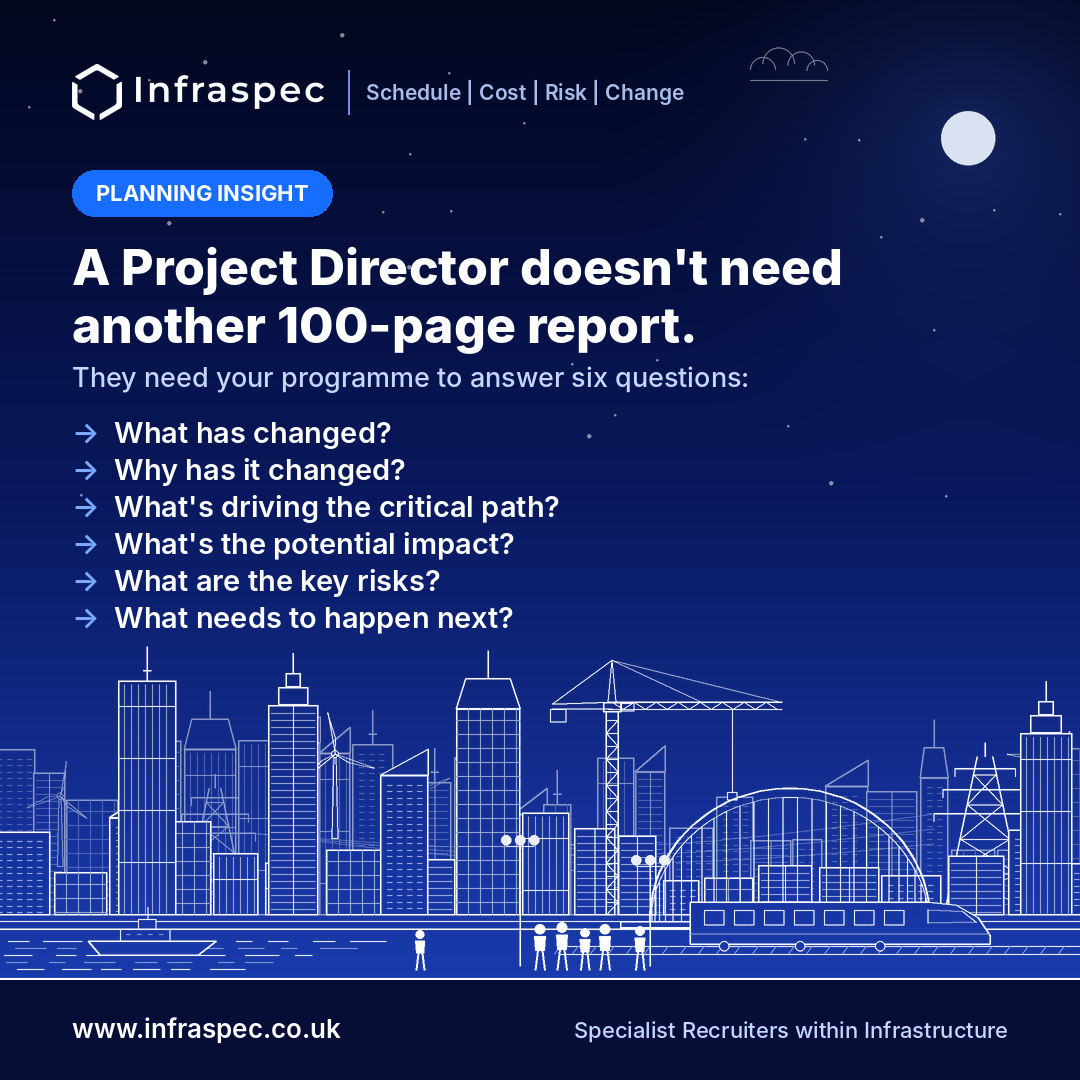
A Project Director doesn’t need another 100-page report.
They need to understand what is happening on their project, why it is happening, what the consequences could be and what needs to happen next.
That is where great planners add real value.
Planning is far more than building and updating a programme. Primavera P6 expertise, scheduling knowledge and an understanding of the critical path are important technical skills, but the best planners combine these with commercial awareness, communication and the ability to turn complex programme data into information that a project team can actually use.
A good programme should help answer six fundamental questions.
1. What has changed?
Projects never stand still.
Design develops. Access dates move. Procurement can take longer than anticipated. Productivity changes. Variations are instructed and interfaces between contractors evolve.
An effective planner needs to identify these changes rather than simply update dates in the programme.
What has moved since the previous update? Which activities have slipped or improved? Have milestones changed? Has float been consumed?
Understanding change is the starting point for meaningful programme analysis.
2. Why has it changed?
Identifying movement isn’t enough. A strong planner looks for the reason behind it.
Was an activity delayed by late design information? Has procurement affected the planned sequence? Is productivity below the level assumed in the programme? Has a change instruction affected the works?
This is where planners need to engage with the wider project team.
Speaking with Project Managers, Engineers, Commercial Managers, Quantity Surveyors and delivery teams provides the context behind the programme data.
Without that context, a programme can tell you what happened without necessarily explaining why.
3. What’s driving the critical path?
Identifying the critical path is a fundamental planning skill. Understanding what is driving it is much more valuable.
A planner should be able to explain the sequence of activities controlling completion and how that position may have changed.
Perhaps an activity that previously had float has now become critical. Maybe the critical path has shifted from design into procurement or construction.
Simply reporting that an activity is critical doesn’t provide the whole story.
The project team needs to understand why it is critical and what can realistically be done about it.
4. What’s the potential impact?
Once an issue has been identified, the next question is what it means for the project.
Does it threaten a contractual milestone?
Could it affect another contractor or work package?
Does it create additional pressure elsewhere in the programme?
Could there be a commercial or contractual consequence?
This is where technical planning starts connecting with wider project and commercial decision-making,
particularly when dealing with programme change and change control under NEC contracts.
5. What are the key risks?
A programme is also an important tool for looking forward.
Strong planners aren’t only reporting what has already happened. They are looking at what could happen next.
Where is float becoming tight? Which interfaces could become problematic? Are there activities dependent on approvals or information that hasn’t yet been received? Are programme assumptions still realistic?
This is also where planning and project risk management increasingly overlap.
Understanding schedule risk and engaging with processes such as Quantitative Schedule Risk Analysis (QSRA) can help project teams understand uncertainty rather than relying purely on deterministic dates.
The planner’s role is therefore not simply to maintain the schedule. It is to help the project understand where future pressure may emerge.
6. What needs to happen next?
Arguably, this is the most important question.
Programme reporting should support action.
If a milestone is under pressure, what needs to change?
Does the sequence need reviewing? Is additional information required? Does a decision need escalating? Can activities be resequenced? Does the project team need to focus resources on a particular area?
The best programme analysis helps the delivery team make better-informed decisions.
Technical skills are only part of being a great planner
There will always be significant demand for strong technical planning capability across major infrastructure and engineering projects.
Primavera P6, critical path analysis, baseline management, progress measurement, change control, schedule risk and NEC contract knowledge can all be extremely valuable.
For professionals developing their careers in this area, our Project Controls Career Guide explores the skills and experience that can help you progress within Project Controls.
But technical capability alone doesn’t necessarily make someone a great planner.
The strongest planners can take that technical knowledge and communicate it clearly to different audiences.
A Project Director may want the overall impact and decisions required.
A Project Manager may need to understand sequencing, interfaces and upcoming constraints.
A Commercial Manager may be interested in programme change and its potential contractual implications.
Being able to adapt the message without losing the underlying detail is a valuable skill.
Don’t just produce the programme
If you’re developing your career in Planning or Project Controls, don’t concentrate exclusively on becoming better at using the software.
Learn to understand the project behind the programme.
Ask questions. Challenge assumptions. Speak to the delivery and commercial teams. Understand the contract. Develop your commercial awareness. And become comfortable explaining complex programme information clearly.
Because ultimately:
Don’t just produce the programme.
Understand it. Challenge it. Explain it.
That’s where planners can add significant value to major infrastructure projects.
Looking for your next Planning opportunity?
Infraspec specialises in recruitment across Planning, Project Controls, Risk, Commercial Management and Quantity Surveying within the UK infrastructure, construction and engineering markets.
If you’re a Planner, Senior Planner, Planning Manager or Project Controls professional considering your next career move, contact the Infraspec team for a confidential conversation about the market and current opportunities.